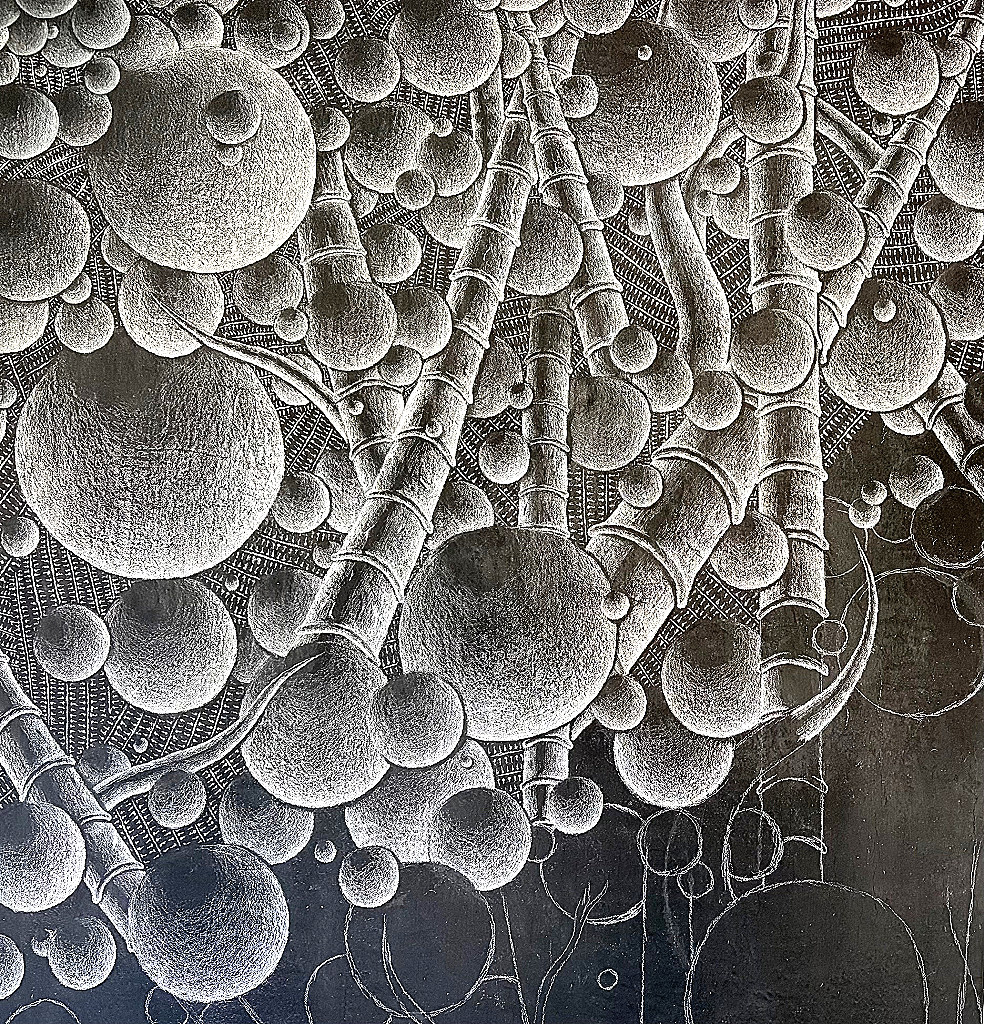
On material research, chaos, and the search for an alternative reality.
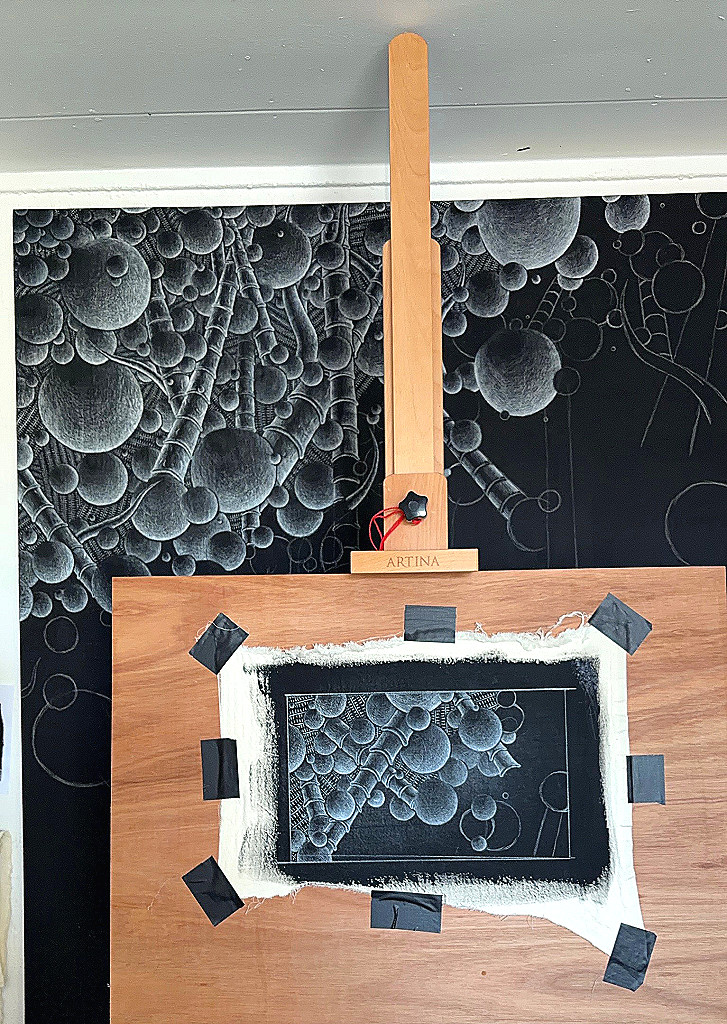
A lot has been happening in my artistic practice over the past few weeks. Recently, I received confirmation that I will have a new workspace. Yes, that means we'll soon be moving the studio.
Although… studio?
At the moment, there's a canvas measuring 140 centimetres wide and 240 centimetres high standing in the middle of my living room. With less than ten centimetres between the canvas and the ceiling, it's fair to say I'm pushing the boundaries of my current workspace.
But that doesn't stop me from working on it. Quite the opposite.
The large canvas has been standing there for a while now, slowly beginning to form a world of its own. A world in which organic shapes, bamboo, floating spheres, and root structures come together. Where light and shadow don't always behave as you would expect. A world that becomes increasingly complex the longer I look at it and work on it.
Two weeks ago, I started working on a new study. Not just a sketch, but an experiment in which I want to test the underdrawing of the larger work. It requires quite a bit of focus and problem-solving.
And what a pleasure it is to figure all of this out before applying the same techniques to the large canvas.
Measuring just 21 by 36 centimetres, it's a remarkably modest little canvas. Especially compared to its big sister in the living room. Yet despite its small size, it's developing more and more character and beginning to establish a presence of its own.
What's fascinating is that such a small study can sometimes tell you more than the larger work you're actually creating.
Before starting this study, I had already carried out several material experiments.
My goal was to make the materials and the underlying surface work together as harmoniously as possible. The canvas was prepared with black gesso, on which I work with charcoal, graphite, and white watercolour pencil, among other materials.
That may sound simple, but these materials behave very differently.
Charcoal can spread beautifully across the surface, while a watercolour pencil offers greater control over lines and highlights. The black background plays an equally important role. It isn't merely the surface supporting the drawing; it becomes an active element within the image itself.
Building up the different layers proved particularly challenging.
How do you apply a new layer without wiping away the drawing underneath? How do you maintain contrast? And how do you ensure that the different materials enhance one another rather than work against each other?
It became a search for the right sequence, pressure, transparency, and intensity.
Gradually, I began to understand the materials better. When I thought I had discovered enough, I turned my attention back to the large canvas. But standing in front of it, I realised that too many questions remained unanswered.
I understood how the materials behaved individually, but not yet sufficiently how they would interact within the complete composition. And so, there was more figuring out to do.
That's how that lovely little study canvas came into existence.
No longer simply experimenting with materials, but investigating how the image should actually be constructed. A smaller version that comes as close as possible to the reality of the larger work.
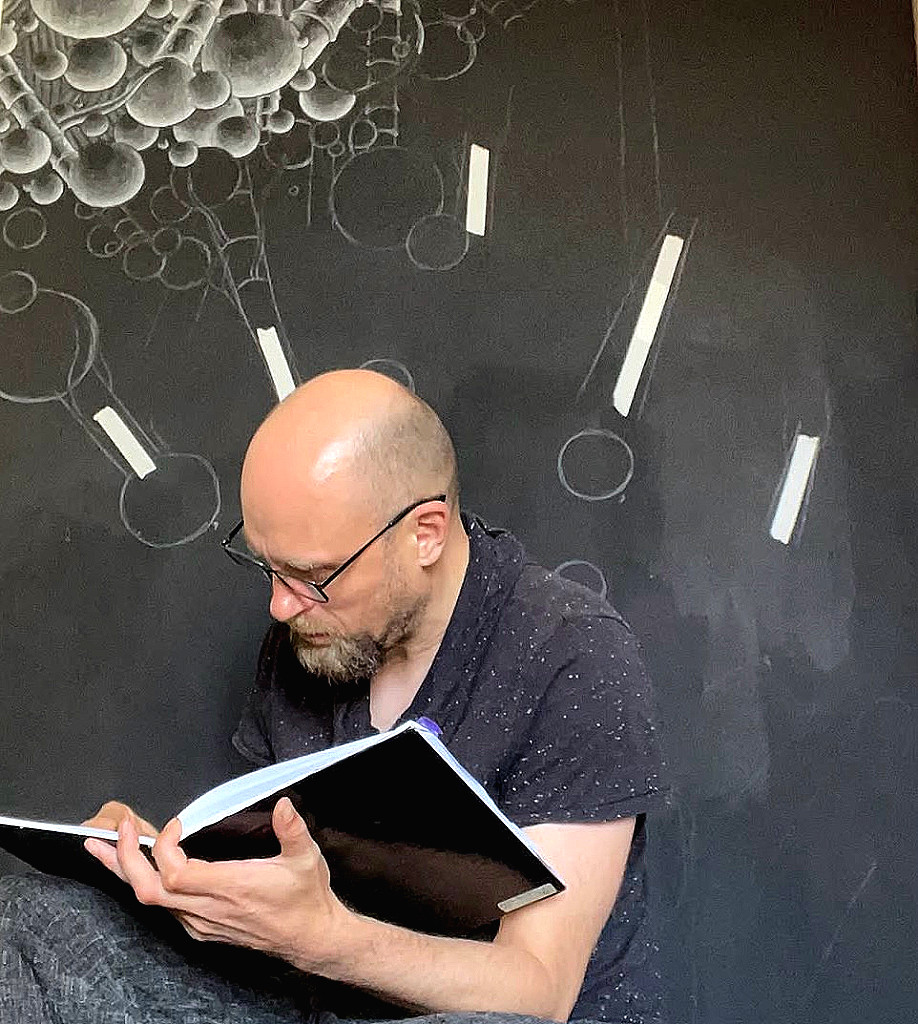
While working on this small study, I couldn't help thinking about Rembrandt van Rijn and his The Night Watch. We also know a smaller painted version of that monumental work, which invites us to reflect on the relationship between composition, preparation, and the final artwork.
Of course, you don't start working on a small canvas imagining that you're following in the footsteps of one of the greatest Dutch masters. But sometimes you recognise something of a centuries-old tradition in your own working process.
Exploring compositions, studying materials, and searching for the right balance before beginning the final work.
It also takes me back to my time at art school. There, it wasn't simply about creating a beautiful final result. It was about investigating, experimenting, and understanding the materials.
The dialogue between artist and material. Sometimes you try to make the material do exactly what you want. At other times, the material tells you what's possible. And it's precisely within that interaction that something interesting begins to emerge.
What initially feels like a technical challenge gradually transforms into an artistic conversation.
There's something peculiar about the small study.
The roots are missing.
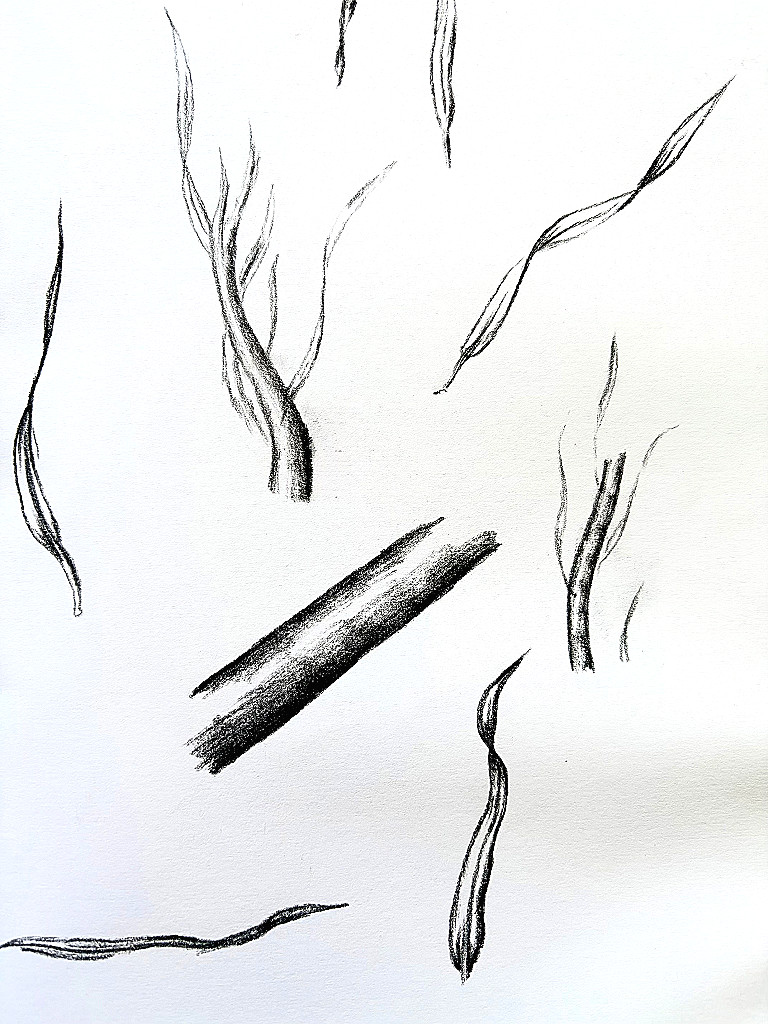
In the larger work, root structures form an important part of the composition. They connect different elements, intertwine, and give the chaos additional weight.
But in the small study, they're nowhere to be found. I asked myself why.
Roots appear regularly in my work. Not only as natural forms, but also as connections between different worlds. They can provide stability, hold things together, or penetrate a surface and disrupt it.
Sometimes they emerge almost out of frustration. When a composition refuses to behave the way I want, roots can become a way of connecting different elements after all. An organic solution to a problem I've created myself.
But not this time.
In the small study, I simply didn't feel the need to add them. And that's actually quite remarkable.
In the larger work, the roots were a very deliberate choice. They didn't emerge from frustration, but from a desire to give the chaos more weight. They strengthen the connections between the forms, while simultaneously making the image more difficult to read.
In the small study, that additional layer doesn't seem necessary, at least not yet.
Perhaps that's because the smaller composition has a different balance. Perhaps I need the roots in the larger work to bring its scale and spatial relationships together more effectively.
Or perhaps the study is showing me that not every space needs to be filled.
I find that last thought particularly interesting.
Creating chaos isn't difficult. Organising chaos in such a way that something meaningful emerges is an entirely different story.
A Negative Reality
The provisional working title of the piece is Negative Balls.
That name emerged during one of my research sessions, when I placed a positive and a negative image of the composition side by side. Suddenly, something became visible that I had deliberately incorporated into the work, but whose impact exceeded my expectations.
The spheres and bamboo behaved negatively in terms of their lighting compared to the cast shadows.
Normally, we expect the side of an object facing the light to appear brighter, while the side facing away from it becomes darker.
But what happens when you reverse that logic?
What if the light falling on an object is represented as a negative of our reality, while its cast shadow behaves exactly as we would expect?
Something peculiar begins to happen.
Our brains are constantly trying to make sense of what we see. We recognise shapes, interpret shadows, and draw upon our experiences to combine that information into a logical image.
But when that information contradicts itself, confusion arises.
And it's precisely that confusion that interests me.
I want to create a dramatic and somewhat unsettling image. A world that appears familiar at first glance, yet where something fundamental doesn't quite make sense.
The floating spheres, bamboo, and organic structures seem to belong to the same reality, while the way they interact with light tells a different story.
It's a play between positive and negative, between what we think we're seeing and what is actually present on the canvas.
For me, this transforms the drawing into something more than a composition of forms. It becomes an investigation into perception and reality.
Because how much of what we see is actually determined by our expectations?
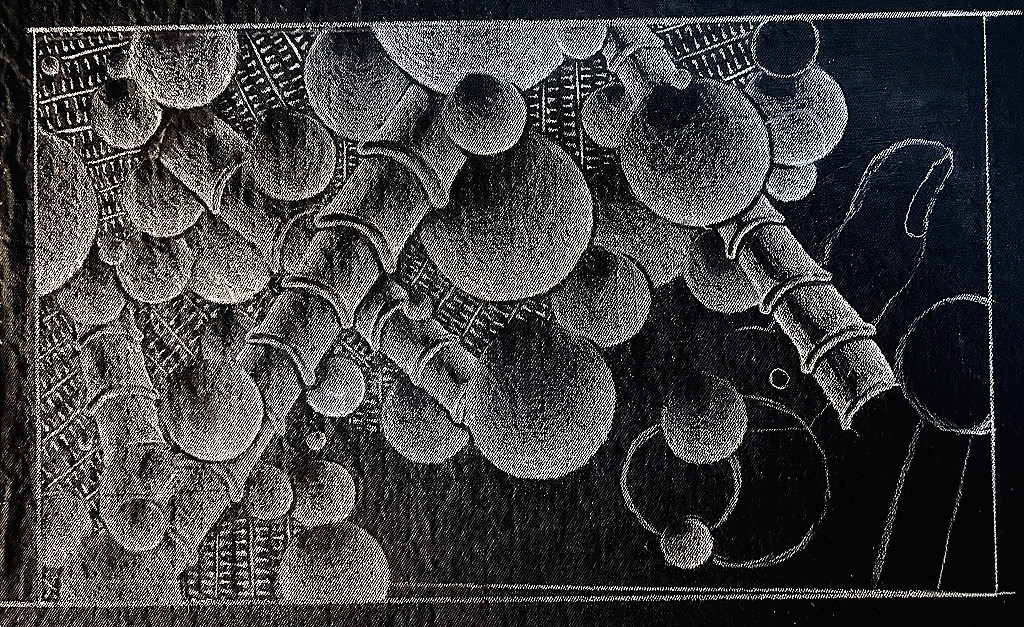
In my work, I often explore the tension between nature, humanity, and the structures we attempt to impose upon our surroundings.
We want to understand, organise, and control. But nature doesn't always follow the direction we would like it to take.
A root grows wherever it finds space. A plant finds its own way towards the light. Structures change, intertwine, and grow through one another, without concern for the order we try to establish.
I recognise that same tension in my own creative process.
I can spend hours researching materials, constructing a composition, and controlling contrasts. And yet there always comes a moment when I have to let something go.
A moment when the drawing no longer follows only my intentions, but seems to choose a direction of its own.
Perhaps that's one of the most important reasons why I enjoy creating these studies so much.
They give me the freedom to make mistakes, reconsider expectations, and discover new possibilities.
Without every decision immediately affecting the larger work.
Not because the large canvas isn't allowed to contain mistakes, but because I want to understand the choices I'm making and why I'm making them.
For me, the contrast between positive and negative isn't limited to the way light and shadow are represented. That contrast also plays an important conceptual role.
We live in a world where countless things constantly demand our attention. A world filled with impressions, expectations, and information.
It's easy to lose sight of the bigger picture.
To see only the chaos and no longer recognise the connections within it.
Perhaps that's also what I'm trying to explore with this work.
Not every reality is what it appears to be at first glance. And not everything that feels uncomfortable or confusing necessarily has a negative meaning.
Sometimes you need to look a little longer to discover something different.
Sometimes an image asks you to let go of your initial judgement.
And sometimes, it's precisely within the chaos that you can create a moment of peace for yourself.
My hope is that through this work, I can give a positive twist to a negative image.
That, as a viewer, you take the time to look beyond the chaos. To see not only the individual forms, but also the relationships between them.
To stop thinking, just for a moment, about everything you're supposed to see, and instead focus on what you're actually experiencing.
Because ultimately, I want to create something with this work that goes beyond the drawing itself.
A moment in which you can leave the noise of the outside world behind.
A positive glow of warmth, in which you might find yourself a little closer to who you are.
But before we get there, there are still quite a few layers to build.
And that little study canvas?
For now, it still has plenty to tell.